Day 1 The Journey Begins

5The Lord saw that the wickedness of man was great in the earth, and that every intention of the thoughts of his heart was only evil continually. 6 And the Lord regretted that he had made man on the earth, and it grieved him to his heart. Genesis 6:5-6
Well, this ancient globe has managed to make his way around the sun to Christmas once again. The Lord, for His own reasons, has chosen not to return and blot out the iniquity of mankind. Once again, we face the ecstasy of the Advent season, mingled with sorrow for the pain we witness; pain that we largely visit upon each other for no good reason. Advent calls me to celebration and examination.
Despite our many advancements in science, technology, and the arts, we remain a failed race. A brief scan of the headlines reveals a litany of crimes and abuses we visit upon each other. The weight of the pain and hurt is staggering. Our leaders fail us. They seem bent on only enriching themselves on the backs of the poor, marginalized, and the globe itself. The rich ignore the plight of the poor. The evil actively seek to grind them down. Those of us in the nebulous middle struggle to understand what to do. Though it describes the ancient world before the flood, the Genesis passage seems apropos today. As Paul said in Romans 8:19-21,
19For the creation waits with eager longing for the revealing of the sons of God. 20 For the creation was subjected to futility, not willingly, but because of him who subjected it, in hope 21 that the creation itself will be set free from its bondage to corruption and obtain the freedom of the glory of the children of God. Romans 8:19-21
Advent points me to the answer to this vexing question, what about all the suffering I see around me. We are so cruel to each other, and it seems to be getting worse all the time. I must limit my intake of news to keep my mental stability. If I’m not careful doom scrolling takes over and my outlook becomes grim and dark. Advent calls me to look at my world with clear vision, seeing the darkness and decay. But while Advent forces me to examine the state of the world, it also speaks to me about hope, rebirth, salvation, and restoration. So join me as over the next few days we take the journey God offers, the journey to a cradle in a small hamlet where salvation lies.
Day 2 Cold Hearts

12And because lawlessness will be increased, the love of many will grow cold. Matthew 24:12 English Standard Version
I like staying in the mountains. Certain responsibilities keep me tethered to Lubbock, but truly I enjoy the splendid isolation of the mountains. It is quiet there. My neighbors do not bother me. It is rare for someone to knock on my door. Alamogordo offers me all that I need in the way of “stuff.” But even in Alamogordo, I must confront the fact that even in this time of abundance, there are many who feel the pinch of want and the pangs of hunger. I see them, the homeless, as I come and go. Our nation has increased its share of impoverished people and families.
Recent political wrangles revealed that in many of us our hearts have grown cold. We simply do not care. We’d rather expand certain portions of our national budget while curtailing programs designed to alleviate suffering. We blame the poor for being poor. Of course, some made poor decisions which led them to their needy state. But we don’t care. Let them suffer. Let their families, their children suffer. Our hearts have grown cold.
We elect officials to pursue policies that separate families. We deploy squads of masked men who go out and round up people suspected of being here illegally, and then ship them away to some unknown destination denying them due process. We do not care that we tear families asunder, forcing parents to make heart-breaking decisions in a few moments. All in the name of securing our borders. Our hearts have grown cold.
We support the policies that enrich a few at the expense of the laborers that keep food on our tables and society functioning. A significant number of people must labor at multiple jobs in an often-futile attempt to make ends meet. We decry any move to better remunerate the laborer. Instead we applaud astronomic salaries and compensation packages for the executive that fires thousands of workers in the name of efficiency. Our hearts have grown cold.
As I take stock of our society, I am forced to conclude that our hearts have grown cold. As long as we are comfortable and can enjoy the good life, we do not care about those who barely scrape by. Our hearts are stone cold. As we begin this journey to Advent we must first understand our desperate need. A shortage of resources does not exist. We face a shortage of compassionate hearts. Looking around we must conclude that lawlessness abounds, and our hearts are cold. We need an infusion of the light of love to stir in our hearts a modicum of compassion for those who suffer. We need Christmas.
Day 3 Power Run Amok

The people of the land have practiced extortion and committed robbery. They have oppressed the poor and needy, and have extorted from the sojourner without justice. Ezekiel 22:29 English Standard Version
As an officer in the Army I wielded significant power. My commissioning certificates all have a line about those of lesser rank being required to follow my orders. Through long experience, the Army recognized that sometimes officers and NCOs abuse their authority and torment those of lesser rank; consequently, the service developed various mechanisms, the Inspector General and the like, that keep those in power in check. Unfortunately, our society does not provide the same stringent measures, and we see those in power running over the poor. This is not a new situation. The powerful have a long history of abusing those of lower rank and wealth.
God never intended it to be this way. He desires that those with power use their power to create justice and protect the weaker members of society. As we consider Advent and the state of our culture, we must confront the fact that the powerful do not care about matters of justice. With our support, they use their power and influence to enrich themselves at the expense of the weaker and lower members of our nation. The poor and weak need protection from the powerful.
He shall not judge by what his eyes see, or decide disputes by what his ears hear, 4 but with righteousness he shall judge the poor, and decide with equity for the meek of the earth Isaiah 11:3b-4
The ancient prophet spoke of the coming Messiah, as one who would dispense justice and equity. When we look across our nation, do we see justice and equity dispense for the poor and the meek? At this, the beginning of the season of Advent, we must consider justice in relation to wealth and poverty. A dispassionate eye cannot help but see that we have failed and failed grievously. We need the Messiah to bring about justice and mercy for the weakest members of our society. Advent should usher in a renewed interest in taking care of the poor. After all, He came to be their defender against those who would crush and abuse them.
Day 4 Heart Disease

9The heart is deceitful above all things, and desperately sick; who can understand it? Jeremiah 17:9 English Standard Version
I take a statin to keep my cholesterol in check. I monitor my blood pressure. I try to exercise enough to elevate my heart rate at least five times a week. I keep track of my weight, avoiding eating too much. I do all of this to keep my heart healthy. I want a healthy heart in hopes of living a long and pain-free life. But all that I do, all the meds, all the exercise, all the proper eating will not fix my fundamental problem. My heart is desperately sick and there is nothing that I can do to fix it.
Perhaps this is why I so easily look at others with judgmental eyes. Finding faults in them makes me feel better. I must think that somehow their failure is worse than mine. I do clean up nicely. On the surface, I’m pretty good. I do not beat my wife. I love my children. I worship regularly. I’ve been known to drop a few coins in the collection plate. I haven’t stolen anything…recently. I’m a good neighbor. I pay my taxes. But scratch the surface and you find out that I’m just as bad as the next man.
I do not like looking at my heart too much. You see beneath the nice, pleasant veneer, beats a desperately sick heart. My heart is a bedlam of pent up anger, selfish urges, hidden lusts, and dark thoughts. A lifetime of being a soldier, followed by a career as a teacher, has left me rather critical and given to fault finding. Poke me and a grumpy, angry, old man lashes out. Oh, I try to keep him under lock and key; but, he is there always ready to strike. No, I’m not a good man, not really. I try. But I fail, just like everyone else.
I need Advent. We need Advent. Over the past few days we have taken pot shots at easy targets, our culture, the rich, the powerful, the other. That is easy. It is easy to criticize someone else. It is simple to lambast the masses that make up our society. But when we look in the mirror, honestly look in the mirror, we find that we’re just as horrible as the next guy. Our fellow travelers to the grave may look over say, “You’re not so bad.” But they do not see inside our minds or behind closed doors. They do not hear the muttered curses when things do not go our way. But we do. We know that there is something desperately wrong with us, and we are powerless to fix it. We know that we need Advent. We need something to change the trajectory of our lives, to do that delicate open-heart surgery that no human can do. We need an Advent experience.
Day 5 Walking in Darkness
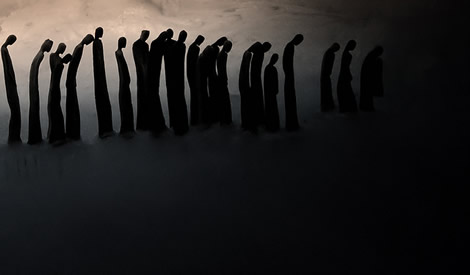
2The people who walked in darkness have seen a great light; those who dwelt in a land of deep darkness, on them has light shone. Isaiah 9:2 English Standard Version
As a soldier, I had to learn to be comfortable operating in the darkness. Nighttime operations come with a variety of hazards. Once I walked off a precipice while engaged in a movement to contact in the middle of a dark Fort Riley, Kansas night. Once I had to locate and lead a resupply convoy to a unit in desperate need of fuel by sound in the dark. Once I placed my command post behind an anti-tank ditch and my commander almost died when he fell into it and his driver almost drove the HMMWV into it on top of him. But perhaps the worst, was being lost on Baghdad International Airport during a counterattack and not knowing where the friendly forces and enemy were. Darkness is perilous. Yet, a quick scan of the news headlines reveals that we live in darkness, deep darkness.
Light reveals much. I like to look at the faults of others; however, the light reveals my own faults. Once during a nighttime operation, we stopped to snatch a few moments of sleep. Dawn revealed that the soft comfortable spot on which I had lain my head was a bag of rotten garbage. For the rest of that exercise, I reeked of garbage juice. The light of Advent reveals things I need to correct; in myself and in my society.
Without Advent we stumble along falling and sleeping on garbage. With Advent we see more clearly. A bright light shines into our darkness, and we can make better decisions, choosing a better path, avoiding stepping on painful things. Every parent knows the pain of stepping on a Lego, Hot-Wheel, or other small toy while checking on a sleeping child. Advent, the arrival of the Messiah, points us to a better path. Advent floods our darkness, inner and outer, with a bright stringent light revealing much.
Day 6 My Sins Are Ever Before Me

3For I know my transgressions, and my sin is ever before me. Psalm 51 English Standard Version
I do not like thinking about my failures. I do not like being reminded of my past transgressions. So why would I start my Christmas Musings by spending time exploring the failed state of mankind, including myself? After all this is the season of light, joy, celebration, gift-giving, beautiful music, and great food. Such a grim task doesn’t fit within my rubric of the season of light, of the Advent of the Messiah. But starting with this examination serves two purposes in my annual journey to Bethlehem.
It reminds me that my sin required payment. There was no easy solution to my problem. Saying that I’m sorry would not fix the problem. All the tears I could shed would not wash away the stains of my sin. My sins called for some sort of payment and that necessitated the incarnation. Our culture, for all its splendid achievements, is broken and failed. Our advancements have not eradicated pain and hurt. The rich and powerful still crush the weak, poor, and marginalized, just like the Roman empire of the first century. We cannot look down on them.
Self-examination forces me to admit that I’m not any better than anyone else. I may clean up well. My years as a believer have given the Lord time to scuff off many of the rough edges; but, I’m still not perfect so I cannot look down on others for their failures. We’re all in the same position. We need someone to fix our problem. And one of my significant problems is that I tend to be judgmental. I tend to emphasize other’s failures while minimizing my own. Remembering my own failure helps me to be more gracious and kinder to others when they fail. My need for a savior, for Advent forces me to confront my own failure and our corporate failure.
So contemplating my failure and our corporate failure is a good place for us to start our Advent journey. Understanding our desperate plight and great need generates great joy because we understand the great gift of the incarnation. The joy and relief we feel bursts forth in praise, thanksgiving, and yes, gift giving.
Day 7 He Came for Me

12What do you think? If a man has a hundred sheep, and one of them has gone astray, does he not leave the ninety-nine on the mountains and go in search of the one that went astray? 13 And if he finds it, truly, I say to you, he rejoices over it more than over the ninety-nine that never went astray. 14 So it is not the will of my Father who is in heaven that one of these little ones should perish. Matthew 18:12-14 English Standard Version
I always dreaded the elementary recess practice of letting kids choose the teams. Unless it was football or perhaps kickball, I feared being chosen last…a fate worse than death. I hated hearing the sigh followed by the resigned, “Okay, I’ll take Matt.” That was followed by the ignominious shuffle through the red Texas dust. Fortunately for me, I was big and unafraid to hit so when we got around to football, I was one of the early choices. Basketball left me on the sidelines. We’ve all suffered the dreaded being left out. No one makes it through life without having to deal with that empty feeling. Most of us leave that behind in school. We figure out our place in the world and that feeling is just a bitter memory. Sadly, for others who never find their place in the world, the feeling persists into adulthood. Advent changes things.
Advent reminds me that God came for me. I was a lost sheep. God came and found me. As improbable as that sounds, it is true. Jesus, knowing that we would have a hard time really believing that He would come for us, reinforces the lesson through the parable. I like thinking about it. He came for me. I do not bring anything to the game. I have no skills that make me a good choice. I’m certainly not perfect. But He came for me. Say that again in your mind. He came for me.
In Advent God chooses you. He came for you. He thinks you’re that important. He came a long way for you and for me. We are indeed chosen. We are of great value to Him. At the core of the Christmas story is choice. God picked you. He came for you. He did not want you left alone, standing on the sidelines, rubbing the toe of your sneaker into the playground dust. He came for you.
Day 8 Improbable Recovery

1There shall come forth a shoot from the stump of Jesse, and a branch from his roots shall bear fruit. Isaiah 11:1
As a young officer, I learned very quickly to discard the word probably when speaking to more senior officers. They seemed to have an innate hatred for that word. As I accrued experience and rank, I too developed an intense dislike for the word, and the concept. In a business that often deals with life and death, uncertainty is to be diminished as much as possible. Oddly, once the rounds start going back and forth in earnest uncertainty abounds. But in the case of Advent, God, unlike the military, seems to relish improbability.
I love thinking about the improbability of Christmas. So much of the Christmas story, the incarnation, is improbable, starting with the Jewish nation. The Lord required that the Israelites appear before the Priest and make this declaration, “My father was a wandering Aramean…” Deuteronomy 26:5. Evidently, God wanted His people to remember their lowly vagabond ancestry.
The Israelites were not an imposing group. They arrived in Egypt as beggars. Had God not sent Joseph ahead they would have been either turned away or enslaved. Trapped in slavery, they need divine intervention to bring them out as a somewhat bedraggled group. Even in the Promised Land they did not inspire much in the way of admiration or fear. Except for a brief heyday under David and the Solomon, they never really amounted too much. But God, who savors making much out of little, or in the case of creation, nothing uses the “wandering Aramean” to save the world. Through the old prophet, He points out that through this failed group of people, “the stump,” He will do something new, something that saves the world. God just delights in confounding our human expectations…and He still does today.
Christmas, a time of improbabilities, always reminds me that God loves surprises. He saved the world by causing a stump to sprout again. Imagine what He can do with you or me. I may have passed my prime, starting to collect social security; but, God can still use me. He may have something unimagined in store for me. He may cause a shoot to spring up out of this wizened gray stump. Christmastime makes me wonder. I mean, if God can use a wandering Aramean, He can do something new and interesting with me. It’s like a wonderfully wrapped gift He presents for me to open.
Day 9 Valleys Lifted Up

4Every valley shall be lifted up… Isaiah 40:4a English Standard Version
“Private, if I wanted your opinion, I’d rip off your arm and beat it out of you!”
As a young private in the Army of the early 80s, I heard that more than once. It was how older NCOs responded to any private who had the temerity to offer an opinion on anything. It was designed to keep us in our place, and it worked. Truth be told, as a private I thought I knew things, but I did not. No private really understands how things should be done. But, I never forgot how low that made me feel. Later as an NCO and as an Officer, I tried to avoid demeaning speech…most of the time. Our society enjoys keeping people in their place. Mercurial leaders relish the chance to heap abuse on those they think beneath them. While we may not engage in such vocal abuse, most of us are comfortable in ignoring the faceless, often voiceless, individuals that move in and out of our view without recognition.
The Lord has plans for those people who occupy the lower strata of every society. He will lift them up. God has a heart for those whom society disparages. Those of us who occupy the more comfortable positions in our world don’t like this salient fact. We, like the Pharisees of the first century, enjoy our comfortable places, and the status quo which keeps us in them. But, God wants to improve the lot of the faceless. He wants them to understand that they indeed have a place in His worldview. They matter. We may disregard them, but their creator loves them and reaches out to them to lift them up.
Advent is a time which reminds us that the good news is for everyone, particularly those life has crushed. The coming Messiah is the one who lifts up the valley. He restores dignity to those who we ignore. He heals their hurts, binding up their wounds and bringing them into a place of honor. Christmas is a time in which the tables are turned. Those who enjoy plenty must now make room for the shabby ones who’ve sat at the gate waiting for help. We ignore them, He seeks them out. We avoid them, He wraps His arms around them. We expect them to serve us. He bids them to sit at the head of the table. We push them down. He lifts them up.
Day 10 Mountains Made Low

“…and every mountain and hill be made low…” Isaiah 40:4b
We know that God wants to lift up the lowly, to bind up their wounds, to heal their hurts, and sponge away their shame. That is what the old prophet is speaking about when he talks about lifting up the low places. Today, we want to focus on the next portion of that passage, the mountains being made low. I like to think of myself as a man of modest means. And compared to the upper crust of American, I am. But, compared to the world at large I’m in the upper 1.4%. To put it another way, I’m more well off than 98.6% of the global population. I live on a mountain, figuratively and geographically. Almost all my friends would fall into the same class, and perhaps some above me. If you find yourself in the comfortable “middle-class” of the United States, you’re going to be above almost all the world. Put it another way, if you are reading this on a mobile device or computer, you’re probably above 80% of the rest of the world. But is God going to make us low because of the size of our bank account?
I do not think so. God is not against those whom He has blessed materially. It is the state of our heart that He seeks to make low. Another Old Testament prophet, Ezekiel, put it this way, 49“‘Now this was the sin of your sister Sodom: She and her daughters were arrogant, overfed and unconcerned; they did not help the poor and needy.” Ezekiel 40:49 New International Version
I know that this is a rather serious take on Advent, but we must look at scripture clearly. Every year I listen to songs that quote the Isaiah passage and nod my head appreciatively. If I consider the words at all, I think that God must be speaking about those wealthy that live over there. After all, they are the wealthy that need to be brought low. The truth is that I am wealthy and when I forget the needy around me, when I pass them by without helping, when I feel resentful about programs that seek to help the poor, then I am a mountain needing to be brought low.
While Advent is a time of great joy and celebration, it is also a time of self-examination, a time to consider who I am and how I am using the blessings that God has sent my way. I fear that more often than I want to admit, I’m guilty of ignoring the poor and downtrodden, they very ones that the Messiah holds His hands out to and came to save.
Day 11 What is Crooked Will Be Made Straight
…and the crooked shall become straight, and the rough places shall become level ways, Luke 3:5b English Standard Version

Here Luke cribs a portion of Isaiah. That’s one of the cool things about the authors of scripture, they freely lift from one part inserting it into another. As an English teacher, I would have dinged John the Baptist for his lack of attribution. But, who am I to criticize holy writ. In this passage the prophet points me to a difficult part of Advent. It is the part of Advent that we do not spend much time considering; the corrective work of God. We like the incarnation and salvation portion. We eagerly accept the saving work of Jesus; however, He does not stop there. We say, “Thank you very much for saving me. Now, please butt out and let me get on with my life with a minimum of change. No fuss or muss please. I want to hang on to my hang ups, thank you.”
But God is not content with salvation, as magnificent as it is. No, He wants to make things that are crooked straight, or as Isaiah said removing the bumps and potholes from my life. This process is rather intrusive. You see, despite walking with the Lord for some time now, I still have some crooked spots in my life, places which still need the corrective hand of God. Oh, I clean up pretty good; but, God’s not finished with me yet. And truth be told, I do not particularly care for the process. It’s inconvenient and sometimes painful. God wants me to conform to His version of what right looks like. Advent ushers in a great rearrangement of my priorities. Somewhere tucked into a fold of the swaddling cloth wrapping the Messiah is a carpenter’s tool-belt, and He is unafraid to use it.
As the prophets point out, the coming Messiah wants to make things right. He wants to straighten everything in my life, make me plumb. He wields the ultimate plumb-bob. He wants to scrape off those bumps in my road which I may cherish, those hidden angers and resentments need to go. He wants to fill in the potholes of selfishness and callousness towards “the other.” He’s not like some compliant eager to please interior decorator who shows up with books of swatches and paint chips. No, He’s like the building code enforcement contractor who shows up to make things right, bring the faulty wiring and plumbing up to code. So, while Advent is a joyous time when we celebrate God’s salvation. It is also a time of rearrangement of my priorities, attitudes, and choices. As we say in the Army, it’s time to strap on and move out smartly. There are some rough spots that need to go and some crookedness that needs straightening.
12 Christmas Improbabilities

14Therefore the Lord himself will give you a sign. Behold, the virgin shall conceive and bear a son, and shall call his name Immanuel. Isaiah 7:14 English Standard Version
Advent, Christmas, asks us to believe a variety of improbable things. As little children we were asked to believe that Santa somehow made it to all the houses in the world in one night. We were also asked to believe that somehow our good outweighed the bad, guaranteeing presents. In my case, this was quite a stretch…and I knew it. But of all the improbabilities the virgin birth causes many to stumble. I understand. It is a tough sell, the idea that somehow a virgin would become pregnant without engaging in sex. In my experience, that just don’t happen.
Somehow it did. A young woman, probably a teenager, become pregnant without a man. Scripture does not give us any details, but can you imagine the turmoil that caused at home. I can easily imagine my response if my daughter had showed up claiming that her circumstance was actually a miracle. I taught at a parochial school. Once a young girl showed up pregers. That caused quite a stir. We had to make some serious adjustments. It was tough, but we all pulled together and got through it. Sadly, the young man was a toad and did not help at all. The young woman’s family rallied around her and today things are quite good. I wonder how Mary’s parents handled this. The Bible remains silent regarding that.
God, however, seems to revel in improbabilities. The fact that He cares enough about our lostness to do something astounds. After all, as humans we’re a pretty sorry lot. He could have pulled out the consequences card and said, “You made this mess, now deal with it.”
The virgin birth is just one of many improbabilities that flow from the mind of God. He asks us to believe; to put our faith in His plan, no matter how ridiculous or improbable it seems. I guess that is what faith is all about, believing in something despite what our minds say. Gabriel, God’s messenger, asked Mary to trust him when he delivered the stunning news. Mary’s response, “38 And Mary said, “Behold, I am the servant of the Lord; let it be to me according to your word.”
I would have probably asked if my neighbor, Emunah could do it. After all, she’s much more fitted to serve the purpose. But, Mary submits, accepting all the turmoil and chaos such a choice entailed. In true Advent fashion, she exhibits great faith and trust. When we put our faith in Him, like Santa, God delivers.
Day 13 Improbabilities Part II

26In the sixth month the angel Gabriel was sent from God to a city of Galilee named Nazareth, 27 to a virgin betrothed to a man whose name was Joseph, of the house of David. And the virgin’s name was Mary. Luke 1:26-25 English Standard Version
Status matters to humans. Growing up, I lived on the north side of Abilene, going to and graduating from Abilene High School. Among the adolescents of Abilene, there existed a belief that the money in Abilene existed on the south side of town. At some time it was true; however, by the 60s and 70s there were plenty of rich people on the north side of town. But we labored under the false impression that somehow, we lived on the poorer side of town. We looked south across the railroad tracks that divided the city with a certain envy. We were wrong, but that said, there was a certain cachet to a southside address. There was no cachet to a Nazareth zip code.
Nazareth in Galilee was looked down upon by the Jews who lived down south, and perhaps the rest of the small country. As Nathaniel said, “Can anything good come out of Nazareth?” John 1:46 If there had been a first century wrong side of the tracks, Nazareth would be on it. Despite this, God chose this small, despised burg as the place where His son, our savior, would grow up. Oh, He was born in Bethlehem, but He grew up in Nazareth. Mary was also from Nazareth, and it seems that Joseph moved there, or at least his family did. When the census required that everyone return to their home, Joseph made the trek. But eventually Joseph and his little family returned to Nowhersvielle Nazareth.
It is interesting to me that God would have His son grow up with that stigma. Of all the young maidens in Israel, God chose the one who lived in a small insignificant little village in the backend of the region. God was willing to start out humble. Mary was willing to serve. We, in our human wisdom, would choose otherwise. We would choose a better address. We would choose a nicer street, perhaps one with some date palms lining the edges and nice fountains discretely burbling behind well maintained walls. Mary would have servants so that she could spend her days doting on the newborn king. Of course there would be a fine synagogue school with the best teacher for Him to attend. He is, after all, the king of kings. But God does the weirdest most improbable things.
When I look over at someone with a better pedigree and feel the pangs of envy, Jesus knows. When I think that I’m to odd or out of it or too old to matter, Jesus knows. His mother was Mary, from Nazareth. Joseph, His earthly father was a blue-collar-carpenter…more about that later. So, God uses the humble. He sees the heart. He does not care about the zip code. If He can use a lowly maid from a nothing village to bear His son, He can use you. He can use gray old me. He has a plan for the improbables of this world.
Day 14 Improbabilities Part III

1Now after Jesus was born in Bethlehem of Judea in the days of Herod the king, behold, wise men from the east came to Jerusalem, 2 saying, “Where is he who has been born king of the Jews? For we saw his star when it rose and have come to worship him.” Matthew 2:1-2 English Standard Version
I love a good mystery novel. I most enjoy the genre of “Cozy Mystery.” They are usually more focused on character development, setting, and an interesting plot. The blood, gore, and such are kept to a minimum. I enjoy turning over the bits and pieces in my mind as the story unfolds. The mystery attracts me. Perhaps this why I so enjoy ruminating about the wise men, the magi, who come to worship in Matthew.
We know so little about them. They appear from the east, strange men following a star. They go to Jerusalem, inquiring about the newborn king. Redirected, they travel on to Bethlehem. Arriving they give gifts, gold frankincense, and myrrh. They worship. And following instructions received in a dream, they head home a different way. That is all we really know.
Who were these men and how many were there? How did they, Gentiles, know to come and worship? Why did God reach out to these outsiders? What did they do when they got home? So much mystery. So many unanswered questions. All these questions and more roll around in my head each year. Evidently, they mean a lot to the rest of us. Think of all the songs, stories, paintings, and other artworks inspired by the few details we have about them. For His own reasons, God chooses to remain silent. But still, they loom large in the Advent story.
They speak of how much God wants to bring His lost sheep home. He loves all His children. Somehow, He spoke to them, calling them to come and worship. They undertook a long and perhaps dangerous journey. They spent a significant sum getting to Bethlehem. They brough lavish gifts. I wonder if those gifts funded the flight to Egypt and the sojourn there. They comfort me.
Through them God teaches me that I have a place in His plan. As a Gentile, I stand outside looking in. I am not a child of the promise. But God reaches out to me, beckoning me to come to the manger and worship the newborn king. He says to me, “Embrace the mystery. Enjoy the wonder of an enigmatic call.”
So, I do. I cherish the unanswered question. I bask in the knowledge that God just does cool things, unexplainable things, wonderous things. He works out His plan with strange and perplexing mechanisms. Was that a special one-use star? Or was it a comet? Maybe it was some kind of amazing astronomical conjunction? When I ruminate on these things, God gently reminds me that I’m missing the point of the wise men, His magi. His point is that He reaches out across time, space, and theology to bring His followers home to worship.
Day 15 Improbabilities Part IV

46And Mary said, “My soul magnifies the Lord, 47 and my spirit rejoices in God my Savior, 48 for he has looked on the humble estate of his servant. For behold, from now on all generations will call me blessed; 49 for he who is mighty has done great things for me, and holy is his name. Luke 1:46-49 English Standard Version
In our consideration of the improbabilities of Advent, let’s loiter a little bit with Mary, the mother of Jesus.
“You’ll always be that odd guy; but, if you can put up with it, you’ll do just fine. In fact, most of you commanders and peers will appreciate your point of view despite it being different than theirs,” said the serious looking Army doctor. He was explaining the results of the Myers-Briggs test we’d taken. My test results indicated that I was not the normal personality type that the Army focused on. As I went ahead with my career, his prognostication turned out to be pretty accurate. I did not think or lead as most of my peers did; consequently, I was usually on the edges looking in. As time passed, I grew used to my place and was quite comfortable with it, and with one exception, he was correct. I was the odd man out; but, the Army needs a few odd men. Mary occupied a similar odd position.
No one would have picked her to birth the savior of the world, but God did. No one would have expected her to voice one of the great paeans of praise, one that would ring down through the millennia and provide comfort for countless believers throughout time, but she did. It seems that God cannot resist using people that the world does not notice, or disdains, to bring about His glorious will. Mary is one such person.
While we do not know since scripture is silent concerning this, Mary was quite possibly illiterate or at best only marginally educated. Young Jewish women did not attend the synagogue school. Their mothers normally took care of instructing them in the skills needed to manage a household. So, it is more than likely that Mary possessed only the most basic education. But that did not mean that her heart was not full of eloquent love and passion.
When she arrives at Elizabeth’s house her full heart bursts forth in what many call the “Magnificat,” and it is magnificent. It takes its name from the opening phrases in Latin which say, “My soul magnifies the Lord.” Moved by the Holy Spirit, Mary goes on to praise the Lord for what He has done and what He will do through the Messiah. It is a marvelous and beautiful song of praise. It is instructive for all who think that they are not useful to the Lord.
Through the Advent story, Mary reminds us that God uses the most humble to bring about His plan, not the ones the world views and great or mighty. He sends the rich empty away. The meek and lowly have a special place in His heart and plan. When you feel like you’re the odd man out, think of Mary and how this young girl spoke words that glorify God and comfort the humble throughout the centuries.
Day 16 Advent Improbabilities Part V

51 He has shown strength with his arm; he has scattered the proud in the thoughts of their hearts; Luke 1:51
I struggle with pride. I hate to admit it; but, it is a besetting weakness for me. Pride has led me down some very dark paths in my life. Modern Western Christianity eschews much talk about pride. Perhaps, such talk hits too close to home for too many of us. We tend to focus on developing a personal relationship with the Lord, and that’s a good thing. But when I read Mary’s song, I’m convicted.
Mary’s great song springs from a humble heart; one that knows well what it means to be pushed down and ignored. The Jews labored under the oppressive thumb of a seemingly all-powerful Roman empire. Harried and controlled at every turn, the Jewish community had little to be proud of. The magnificent kingdoms of David and Solomon were but a distant and elusive memory. Mary was a young woman, girl probably, and as such inhabited a lower stratum of society. Additionally, she was from a small village far from the power centers of the region. Her fiancé, a humble construction worker, did not add to her status. To be certain, Joseph would have been a respected and needed member of the community, just not one of high rank or status. Most likely she knew her place and her culture kept her there. From her humble heart springs this great song of praise. Tapping into the great prophets of antiquity, she illuminates how God feels about pride.
He scatters the proud. Other passages reveal that God opposes the proud. Evidently pride and arrogance are intrinsically anti-God. Advent forces me to reckon with my own prideful tendencies. In Advent God sets in motion forces that will ultimately humiliate those of us who remain trapped in our own self-will and self-importance. Perhaps that is why we do not spend much time thinking about Mary’s Song. It makes me look in the mirror, and I do not like doing that because I do not like what I see. Each year the arrival of Advent makes me consider how I treat those who are “lower” than myself.
I, and most of those who might read these words, enjoy a certain status in our society. How do I view those who make my world possible? Do I treat the clerk in the store with grace and kindness? Do I even notice them? We tend to ignore those who exist on the margins of society, living in a modern-day version of Nazareth. God does not. He sees their plight and it grieves Him, as does our own intransigence on this subject. As improbable as it sounds, in Advent, God loudly proclaims His view of how things ought to be. The only real question is, how will I respond? Will I join in the celebration or will I end up scattered in my own malicious and malignant thoughts.
Day 17 A Just Man
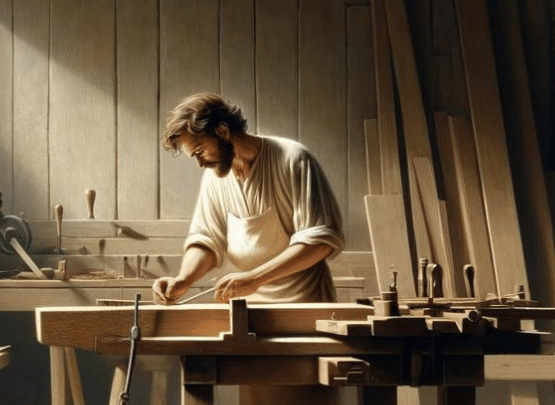
19And her husband Joseph, being a just man and unwilling to put her to shame, resolved to divorce her quietly. Matthew 1:19 English Standard Version
We know precious little about Joseph, the man tasked with being an earthly father to Immanuel. We know he was from Bethlehem. We also know that he was of the house and lineage of King David. We know that he was a carpenter, or craftsman, by trade. We presume that he died sometime during the youth of Jesus. After the incident at the temple, we do not hear about Joseph. He is one of those characters that scripture does not provide much in the way of information. But we do know that he was a “just” man, and that is important.
We often make much of his relatively low place in first century society. He was a carpenter, or craftsman, a man who earned his living with his hands and by the sweat of his brow. We often make much of his “lack” of education; but, I have worked in construction and know that it takes great skill and some knowledge of math, particularly geometry, to succeed as a construction worker. So while not rich, a good craftsman would probably earn a decent, if modest, living. But Joseph is also described as “just.”
Strong’s concordance defines dikaios, the transliteration of the Greek word, as: “just, equitable, fair, of persons, just, righteous, absolutely, righteous by account and acceptance, in ordinary usage, just, upright, innocent, pious.” So Joseph was more than a “good guy.” He was an upstanding member of his community. More than likely he was an active member of his local synagogue. I’m not certain what that looked like in the first century, but he probably did more than drop by on high feast days. As a just man, he would not want to marry a woman who had become pregnant by someone else. But aside from being a righteous man, he must have been kind.
Instead of subjecting Mary to public humiliation and possible death by stoning, he planned to divorce her quietly. Maybe she could slip away somewhere else, a relative’s house perhaps, and deliver the child quietly, avoid execution, and hope for some semblance of a normal life. Many men of yesterday and today, hurt and angered by such a betrayal, would seek some sort of public retribution or vengeance. Not Joseph. He was going to let her slip away and heal his hurt some other way. He was just…just like His son…but also merciful…just like his son. In some ways, the apple did not fall too far from the tree. I wonder who influenced who in this situation. What led Joseph to such an act of kindness and did that act of kindness have some sort of influence on Immanuel. Here, things get too tricky theologically for me. I just like thinking about a just man, a kind man, and how God used him to make a difference in my life.
Day 18 They Came from Afar

1Now after Jesus was born in Bethlehem of Judea in the days of Herod the king, behold, wise men from the east came to Jerusalem, 2 saying, “Where is he who has been born king of the Jews? For we saw his star when it rose and have come to worship him.” Matthew 2:1-2 English Standard Version
I enjoy mysteries. Most evenings, I wind down reading a good mystery. Perhaps I enjoy turning over the clues in my mind, though I really do not try and figure out who dunit. I just let the story unfold. I also enjoy things that I cannot fully explain. Sitting out under the stars, basking in the silvery light thinking about how far that light traveled just to greet me brings me great peace. Those unfathomable things remind me that there is something much greater than I going on here. Deep things. Things that go back further than time itself. The inexplicable is quite pleasant to me. That is why I like the magi, or wise men, in Matthew.
They remind me that God does great big things that stretch my imagination. He works in ways that confound my feeble attempts to explain. He does not seem to care that this story does not fit into my nice neat tight plot arc. They are outliers, something unexpected, something deliciously mysterious and extravagant. They come, they worship, and they go. Their presence poses more questions than it answers.
How did they know? We speculate, but in truth we do not know how they knew. I could trot out my personal thoughts regarding this, but why. Somehow in His divine love and purpose He reached out to them. Like me, they exist outside of the promise. Their presence reminds me that God wants all His children to come home. None of us are left out of the call to come and worship the king of kings, Immanuel. They heard the call and they came.
Where did they come from? All God chooses to tell us is that they came from the East. That’s a big place, the East. Again, we speculate and theorize, but God in His providence chooses to keep that nugget unto Himself. His withholding keeps me in my place, reminding me that I am not able to understand all that He does…and that is okay. Tomorrow I will visit with some Christian brothers in Pakistan, yes technology is a good thing, and I intend to remind them that their ancestors came and worshiped long before mine. That staggers me and humbles me.
How did they know to listen to a dream? We kind of write this off to the primitive willingness to listen to the supernatural. That is easy, but so much of the Advent story hinges on dreams that it makes me wonder if somehow, I’m missing out. Whatever the case, they listened and Jesus and His parents slipped out of Herod’s grasp. Just as mysteriously as they appear, they disappear.
What happened to them? Again, the Bible and the Lord remain silent. They came, they worshiped, and they departed. Did they go home and continue in their worship of Jesus? Did they share the good news and what did that look like?
I have all these questions and all God says is, “Trust me. Do like they did. Seek me out, and I will reveal myself. Come to Me and worship. I will fold you into my plan, and you do not even have to understand.”
Day 19 They Missed It

3 When Herod the king heard this, he was troubled, and all Jerusalem with him; 4 and assembling all the chief priests and scribes of the people, he inquired of them where the Christ was to be born. 5 They told him, “In Bethlehem of Judea, for so it is written by the prophet: 6 “‘And you, O Bethlehem, in the land of Judah, are by no means least among the rulers of Judah; for from you shall come a ruler who will shepherd my people Israel.’” Matthew 2:3-6 English Standard Version
I like education, in all forms. I enjoyed school and I thrive in an academic environment. But I also know that education is a means, not an end. I study to reach a goal, to master a skill, or to better understand my world. Don’t get me wrong, I understand the temptation to make education and the associated status an idol; however, I am not dismissive of knowledge and understanding and the wisdom that arises when you combine them with experience. Like so many before them and after, the Pharisees forgot this.
Enamored with knowledge and study, they forgot to apply their education, take it to heart and live accordingly. They enjoyed all the perks, the prime seats in the Synagogue, the deference paid them in the marketplace, the good parking spot for their asses in front of the temple. They used their knowledge to browbeat others, not serve them. Consequently, they missed out on the biggest event of their lifetimes, the biggest in ours as well.
The wise men arrive in Jerusalem, seeking the new king. Herod, being the jealous power-mad ruler that he was, viewed the Messiah as a usurper. He gathered the local brain trust and got them seeking. They came up with the right answer, Bethlehem. Properly informed the magi move on, continuing their quest. And this is where it gets interesting.
The Pharisees do nothing. They read the scriptures. They knew the prophecies better than we do. Yet, they remain in Jerusalem. Despite the significant sign of the star and hint of the seeking wanderers from the east, they stay put. I wonder, did they even send a junior functionary out the Bethlehem to check? It does not seem like they did. Complacent and satisfied with their rank and position, they missed the chance to go and worship Immanuel.
I wonder, do I do the same. I’m pretty comfortable in my place. I go to worship regularly. I read scripture and pray. I try to live a decent life. But I do not get out of my comfort zone very often. I like my life. I do not want to go out of my regular path. It is well trod and I know where all the stumps, hollows, and pitfalls are. What if God is over in some small burg, waiting for me to come and worship. The wise men trekked across some pretty rugged terrain. I know, I’ve been there. Reading scripture tells me that often God calls us out of our comfort and into His light and service. Following Him may lead me through some rough patches. The real question is, will I be like the Pharisees and remain in my comfortable recliner sipping coffee and watching my favorite shows, or will I go up and follow His leading star and offer up my worship?
Day 20 The Incarnation

14And the Word became flesh and dwelt among us, and we have seen his glory, glory as of the only Son from the Father, full of grace and truth. John 1:14
I started my time in the Army as a private, E-1, or E-Button Hole as we jokingly referred to it. In the military world, I was the lowest of the low. It seemed as if everyone outranked me…and for the most part they did. All the scut details fell my way. Once, while providing support to a neighborhood devastated by a tornado, I was forgotten on guard duty and spent the entire night guarding rubble. After morning roll call, they finally realized that I was missing and remembered that I was out on guard duty. They did come and get me. As I remember it, somehow them forgetting about me was my fault. Such was life as a private. Eventually, I earned a commission and spent the bulk of my career as an officer eventually attaining the rank of Lieutenant Colonel; but, I never forgot what it was like to be a private. That experience forever colored how I viewed life in the Army, particularly the lower ranks. It informed how I treated lower ranking soldiers, how I gave orders, and how I assigned tasks. Needless to say, I never forgot one of my soldiers who was out on guard duty. This experience has also shaped how I view the incarnation.
Though it does not really compare, Jesus becoming flesh was somewhat analogous to a private becoming an officer. I had existed in two worlds, one vastly different in status, authority, and power than the other. Jesus breathed out all that I see and understand as real. He never wanted, never had to learn anything, never was weary, never was weak and powerless. This list could go on for quite some time. But to better know His creation, He entered it. To save His lost sheep, He became one. I understood what it was like to have to stand guard with no relief. As an officer, I understood the pains and turmoil of life as a lower enlisted. In becoming one of us, Jesus learned how we feel experientially.
Are you weary and weak. Jesus knows how that feels. Do you feel powerless and buffeted by life. Jesus was a weak and powerless infant, dependent upon a young inexperienced woman for his care and feeding. All he could do was cry when He wanted something. A soiled diaper, cry. A gassy stomach, cry. Hungry, cry. Tired, cry. Just imagine, the voice that called this world into existence was reduced to gurgling. He had to go through the effort of learning how to speak. The hands that shaped mankind had to learn how to use a fork, spoon, and knife. The feet that strode across the cosmos had to learn how to walk. All of this to know and to save.
Our savior loved us enough to set aside all the power and perks of being a divine God. I’m not a trained theologian, so I will not claim to understand it all. I just know that Jesus, Immanuel, traded glory and honor for a humble birth in a stable. The mansions of heaven were set aside for a straw-filled manger. That kind of love astounds. We serve a savior who knows, intimately knows our lives. All the common joys, sorrows, pains, thrills, and terrors have passed through His mind. So, we can rest easy in the knowledge that He understands our weaknesses and has experienced being lowly. He’s been there, done that, and got the t-shirt.
Day 21 A Place to Give Birth

7And she gave birth to her firstborn son and wrapped him in swaddling cloths and laid him in a manger, because there was no place for them in the inn. Luke 2:7 English Standard Version
“Matt, you’re going too fast,” grunted Christy, as the little Mazda squealed around the bend in the Autobahn. “You’re making the baby slide over inside of me and it’s NOT COMFORTABLE!”
We were headed to the Krankenhaus, German for hospital, where Christy would give birth to our firstborn, a son. As a somewhat tense new father with delusions of auto-sports grandeur, I was driving quite rapidly down the un-speed-restricted Autobahn. I wanted my son to be born within the safe environment of a hospital. Christy had wanted to pursue a more natural birth…at home. I was not thrilled with that idea. After much discussion, Christy relented and we’d made the appropriate arrangements with the German hospital. I was in the Army, and we were stationed in Germany, far from family and familiar surroundings.
I wanted the best for my wife and son; just in case something went wrong. I wanted medical resources available for any problem that might come up. As it unfolded, nothing went wrong and my concerns were unfounded. But I think about Joseph and pregnant Mary, far from home and unable to secure appropriate lodging or medical care, not even a midwife.
The king of the Jews, Immanuel, God with us, was coming soon. The King James Version describes Mary as being “great with child.” They had to make the trek from Nazareth to Bethlehem, some seventy miles. I wonder, did Mary walk or ride on a donkey. Though the Bible is silent on the matter, all of the Christmas cards show Mary on a donkey. Walking that would take four days or so, perhaps longer due to Mary “being great with child.” If Joseph shared my trepidations, he would have secured a donkey. That might shave some time off the journey. Then there was lodging.
Here the Bible is quite clear. “No Vacancy” signs greeted them. Once Christy and I wandered the streets of Merida, in Mexico, late into the night trying to find a place to stay. All the doors were barred and locked tightly. We eventually found a room in a hotel that normally rented by the hour…not the nicest of establishments. Mary and Joseph had it worse. They had to sleep in the barn. All of this points out a most important fact.
Jesus was willing to endure a rough entry into this world, even by first century standards. Whereas I was able to secure good doctors and nurses in a fully equipped hospital, Jesus entered this world in a humble establishment. He stooped awfully low to extend grace and mercy to me, to you. Now I do not think God is so careless as to let His son be born into a situation which would prove fatal. But He did allow Jesus to be born in sub-par circumstances, no doctor or midwife in attendance. Perhaps a cow, sheep, ox, or donkey cast a disinterested eye over the mother and soon-to-be father as they sweated out the labor. Truly this was a step down from the storied and hallowed halls of heaven, a distance He was willing to travel for you and for me.
Day 22 A Personal Invite
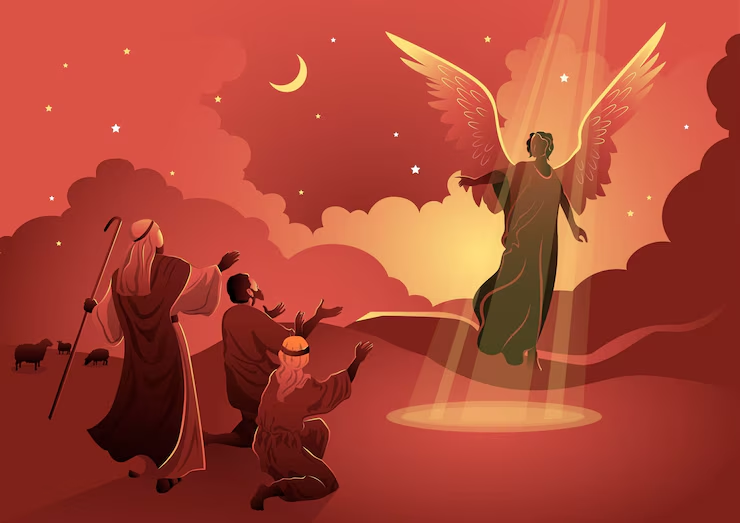
8 And in the same region there were shepherds out in the field, keeping watch over their flock by night. 9 And an angel of the Lord appeared to them, and the glory of the Lord shone around them, and they were filled with great fear. 10 And the angel said to them, “Fear not, for behold, I bring you good news of great joy that will be for all the people. 11 For unto you is born this day in the city of David a Savior, who is Christ the Lord. 12 And this will be a sign for you: you will find a baby wrapped in swaddling cloths and lying in a manger.” Luke 2:8-12 English Standard Version
After a long night of delivery, I was quite tired and I had not even worked. Watching and encouraging Christy during the delivery of Christopher, our first-born, left me drained. I cannot imagine how Christy felt. She did all the work. But nevertheless, I was quite fatigued. I sat on the floor of our quarters in Germany and placed the joyful long-distance call to Abilene, Texas and informed my parents that they were grandparents. Parents love sharing the joyful news of a new birth, an addition to the family, a blessed event. God is no different. He had to share the good news.
Who did He Call? Magi and Shepherds. Of all the people God could have invited to witness the birth of His son, the entrance of God almighty into this world, He chose outsiders and the lowly. The rulers of the Roman empire did not get an invite, neither did the Pharisees. He bypassed the wealthy and influential. Instead, He found a group of shepherds sitting on a dark hillside outside of Bethlehem, watching their sheep and sent the heavenly choir to announce the birth of His son. We would do well to take note of His choice. It should inform us as to His priorities.
God wants to bring in those who exist outside the promise, walking in utter darkness. He wants to bring them into the light. We often ignore those we consider outsiders. Those who walk in darkness, the nonbelievers. They make us uncomfortable. God views them differently. He calls to them, seeking their presence, just like the lowly.
Shepherds in first century Jewish culture were not well respected. Despite their importance to the economy and religious ceremonies, they did not rate much respect. Perhaps, like many today, regardless of their importance to the Jewish culture, economy, and religion, they were not considered important. After all, very few fathers today encourage their children to take up a career in refuse collection; but, let the garbage men go on strike and suddenly we all notice. Whatever their true status, we can know that God chose to inform the shepherds first, those who were tending their flock, that the great shepherd was born and would soon be gathering His flock. It is good to remember that God chose to first tell the humble, those who spent their days taking care of sheep. Perhaps their jobs, tending sheep, better prepared them to understand the human need of a good shepherd.
Day 23 A Weary World Awaits

4 But when the fullness of time had come, God sent forth his Son, born of woman, born under the law, 5 to redeem those who were under the law, so that we might receive adoption as sons. Galatians 4:4-5 English Standard Version
It is 10:30 P.M. here in Lubbock. My house is finally quiet. We gather as a family on Christmas Eve and eat tamales and exchange presents. Tomorrow, Christy, the kids, and I will enjoy our smaller, more intimate, celebration. But for now, I enjoy a bit of peace and quiet. When I was a child, it seemed as if Christmas Eve lasted forever. I remember lying in bed unable to sleep as the moments crawled by. Then the sun finally came up and then we had to wait on my parents who enjoyed a free day to sleep in. The anticipation was almost as sweet as the chaos of tearing into the carefully wrapped presents…almost. We often begged my father to alter our family practice and open at least one present on Christmas Eve. After all, our close family friends enjoyed that practice. But my father was resolute. We had to wait for the right time, Christmas morning.
God is like that. Scripture says, “…in the fullness of time…” What a glorious phrase. Jesus arrived at just the right time. When everything was just right, God became man. The miracle of the virgin birth took place. The wise men made their trek. The Angles scurried back and forth delivering a multitude of messages. The heavenly choir tuned up. Heaven burst out upon the shepherds. Caesar demanded a census, and Mary and Joseph made their journey. All the pieces fell into place and our savior arrived on the stage. Nothing has been the same since.
Christmas Eve is that breathless moment of anticipation. Even today, I gaze at the presents underneath the tree and eagerly anticipate the joyous opening. Of course, all my children are grown so we proceed at a reasonable time. We will eat breakfast first, like civilized people. But Advent always reminds me of the eager anticipation of the arrival of Christ. What will He bring into my life? What changes does His arrival herald? In some mysterious way, Advent happens anew in my heart each year. Weary and world worn, I anticipate the promised renewal Jesus brings. His presence in my life brings its own special presents for me to unwrap as the days pass and the year unwinds.
Day 24 What do I do with the Manger?
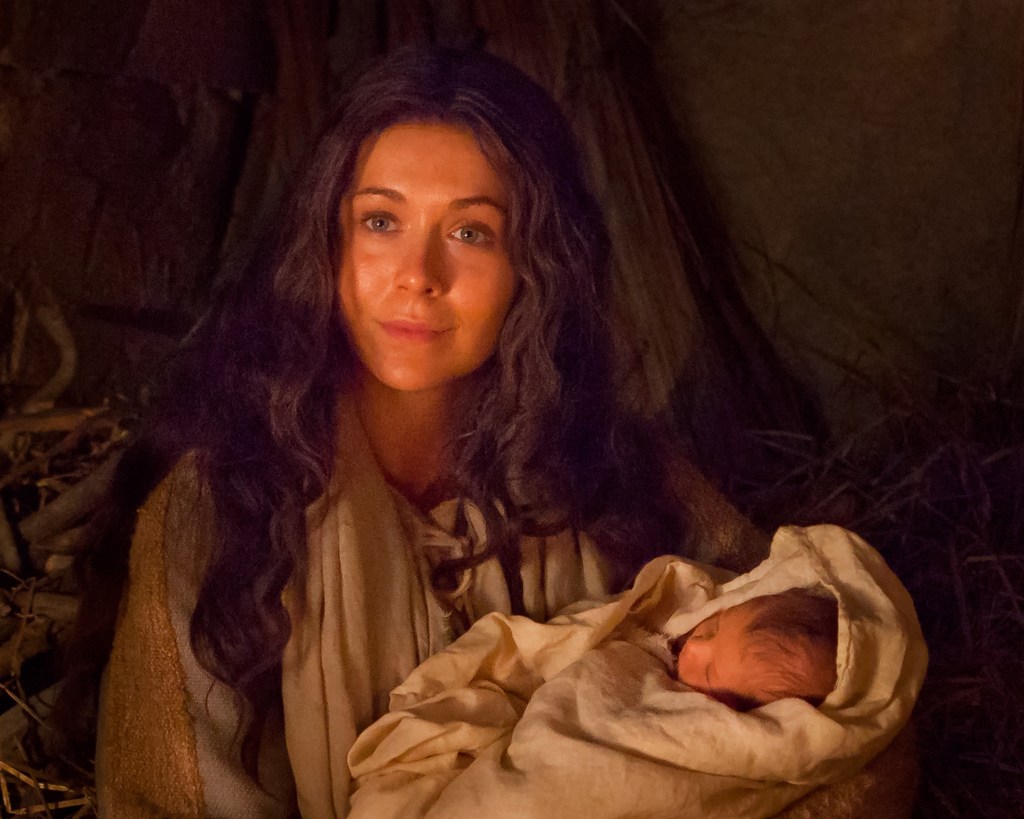
15When the angels went away from them into heaven, the shepherds said to one another, “Let us go over to Bethlehem and see this thing that has happened, which the Lord has made known to us.” 16 And they went with haste and found Mary and Joseph, and the baby lying in a manger. 17 And when they saw it, they made known the saying that had been told them concerning this child. 18 And all who heard it wondered at what the shepherds told them. Luke 2:15-18 English Standard Version
We reached the end of our journey. We unwrapped the presents, ooing and aaahing appropriately. We ate too much ham, macaroni-n-cheese, green bean casserole, banana pudding, and snacks. We watched our Christmas standards. We played some games. We went on a nice walk through the neighborhood. Now, the stockings hang empty. The tree has no presents underneath. The dishwasher gently swishes in the background. The kids are all asleep and I am alone with my thoughts, looking into the manger.
Like the shepherds, I came with haste when I heard, and found the babe lying there asleep, a little drool running down his cheek. Mary gently dabs it away with a soft cloth. Joseph, weary and a little worn, looks on with wonder and joy. What am I going to do with this wonderous event; God become man and lying there in the quiet. How do I fit this incomprehensible event into the framework of my life? What kind of God would choose to become a helpless baby?
I look at Mary. She’s so young and inexperienced. What kind of mother will she be? Does she understand the enormity of the task before her? Do I fully understand the impact of this infant on my life? So many questions swirl in my mind. I do not really know how to answer most of them. I know that I’ve failed miserably. The world is a dark place, a place in which evil seems to often have the upper hand. Scripture tells me that this helpless little boy, wrapped in plain swaddling clothes, will somehow change things. He will shine a light into the darkness, a light that the darkness neither understands nor can put out. I know that I am changed.
Coming here and looking into the manger gives me hope. Just seeing Him so weak and insignificant, yet full of hope and promise makes the impossible seem possible. Just knowing that God put on flesh, putting aside His majesty and power, to somehow save me, makes a difference. His journey to Bethlehem starts me on my own journey. A journey like His.
Quiet laughter from another room drags me back into my quiet peaceful house. Once again, I face the glowing lights of the tree and hear the gentle swish of dishes being cleaned. But it is not the same. It seems a little brighter, a little lighter, a little more hopeful. The manger changed Jesus. The manger changes me.
 On Azimuth